
Directors Steve Cox and Matthew Walker On The Monstrously Fun Makeover in ‘Shaun the Sheep: The Beast of Mossy Bottom’

[Warning: possible spoilers from Shaun the Sheep: The Beast of Mossy Bottom are below!]
Taking Shaun from a Halloween special to a full-blown monster movie
For some, it might be hard to believe, but there was a time when The Beast of Mossy Bottom that we’ve come to know and love wasn’t always meant to be a feature film. The project was originally conceived as a half-hour Halloween special, but as Cox, Walker, and their writing collaborators developed the concept, it quickly became apparent that Shaun’s latest adventure had grown far beyond its original boundaries.
“It was too big an idea,” Walker explained. “There’s too much fun to be had in a half-hour.”
What followed was nearly four years of creative development, animation, and plenty of experimentation. The filmmakers even incorporated elements from an earlier Valentine’s Day concept, creating an unusual combination of spooky shenanigans and heartfelt storytelling. Although the basic premise of Shaun creating a monster that terrorizes the farm remained consistent, much of the surrounding story evolved along the way. Characters changed, emotional arcs developed, and new ideas kept emerging throughout production.

For the directors, that flexibility wasn’t just wanted, but essential. Rather than forcing the story into a predetermined structure, they allowed the comedy and characters to guide the adventure, making room for the unexpected discoveries that often produce the biggest laughs. With Shaun at the center of the madness, plenty of opportunities arose for things to go hilariously wrong.
The handmade magic that keeps Aardman special
In a cinematic landscape where digital technology has dominated in recent years, Aardman’s commitment to stop-motion remains one of the studio’s most distinguishing qualities. For these directors, however, the technique represents far more than a nostalgic artistic choice; it’s an essential part of the studio’s storytelling identity.
“Everything you see on screen is real,” Cox explained.
That means physical puppets, meticulously constructed miniature sets, and animators carefully adjusting characters frame by frame to create the illusion of movement. It’s an extraordinarily demanding process, but it produces a visual warmth and personality difficult to duplicate with other techniques. Perhaps most interestingly, the filmmakers aren’t particularly interested in hiding the evidence of that labor.
The tiny imperfections, subtle textures, and occasional fingerprints are all part of the experience that makes the world of Shaun the Sheep what it is. Rather than seeing those details as flaws, Aardman embraces them as reminders that real artists bring these characters to life. However, with the recent focus on artificial intelligence and its potential impact on animation, Cox and Walker raised that concern. While both directors acknowledged that emerging technology could eventually serve useful purposes within production, they remained confident that human creativity would continue to define Aardman’s work.
Cox pointed to the arrival of Toy Story and the concerns that computer-generated animation might eventually replace traditional methods. Instead, the industry expanded, allowing different techniques to coexist and develop their own artistic identities.
“There’s always room for new technologies and new ideas,” he said.
That perspective feels particularly appropriate for a studio celebrating five decades of animation. Technology may change, but the personality, artistry, and imagination behind Aardman’s creations remain its greatest strengths.
A little horror mixed with that familiar Shaun the Sheep humor
While Shaun the Sheep has never been afraid to embrace the absurd, The Beast of Mossy Bottom introduces the filmmakers to an entirely new playground: classic horror cinema. Foggy landscapes, ominous shadows, a crumbling windmill, and other familiar genre ingredients help establish the film’s spooky atmosphere. But rather than attempting to genuinely terrify audiences, Cox and Walker use those conventions to create opportunities for comedy.
The suspense becomes part of the joke, with familiar horror imagery transformed into visual gags that keep the adventure accessible to younger viewers while offering plenty of recognizable references for adults. Among the inspirations discussed were Psycho, Nosferatu, and The Shining, though the filmmakers emphasized that these influences emerged naturally rather than being included simply for recognition. One of the production’s most ambitious sequences, however, takes its inspiration from a decidedly different kind of horror classic: Michael Jackson’s “Thriller.”
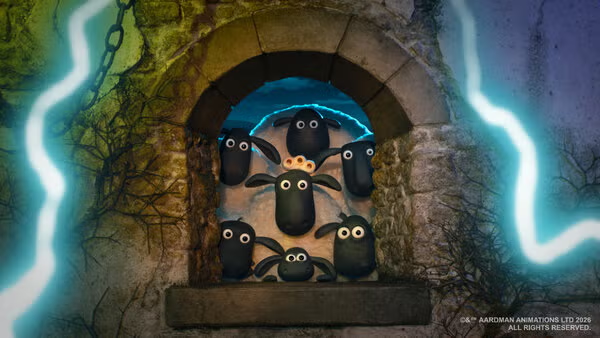
The opening sequence pays playful tribute to the iconic music video’s visual style, complete with elaborate synchronized movement and an unmistakable 1980s atmosphere. Rather than recreating the choreography directly, the filmmakers developed their own interpretation, even recording themselves performing movements to provide reference material for the animators.
“It was an incredibly complicated sequence to animate with all those characters dancing in time,” Walker recalled.
Composer Natalie Holt helped complete the atmosphere with an ’80s-inspired, synth-heavy musical approach that captures the spirit of the era without simply reproducing familiar sounds. It’s precisely the kind of ambitious silliness that makes Shaun’s world so entertaining. What might be a straightforward musical homage in another production becomes an enormous technical undertaking when every character must be physically repositioned between frames. And somehow, that only makes the finished concept more charming.
Finding the heart beneath the Halloween chaos
For all the monsters, mayhem, and horror movie references, The Beast of Mossy Bottom also carries a meaningful message about self-acceptance. One of the film’s central emotional threads involves the farmer, whose insecurity about his baldness leads him to believe that changing his appearance might help him win the veterinarian’s affection. Of course, the irony is that the veterinarian already likes him exactly as he is.
That idea became one of the story’s most enduring elements, surviving numerous changes and revisions throughout development. While the surrounding comedy continued to evolve, the filmmakers remained committed to telling a story about learning to appreciate yourself rather than trying to become someone else. It’s an unexpectedly touching theme for an adventure involving a monster running loose on a farm, but the directors believe that emotional sincerity is essential to making the comedy work.
“We always want the films to be as funny and as entertaining as possible,” Walker explained.
The trick is keeping the characters emotionally believable, even when the circumstances around them become completely ridiculous. That balance has long been one of Aardman’s greatest strengths. Beneath the elaborate slapstick and wonderfully exaggerated personalities, its stories frequently explore recognizable human emotions, giving audiences something meaningful to connect with between the laughs.
When in doubt, let Nuts be Nuts
Of course, no discussion of Shaun’s world would be complete without acknowledging the wonderfully unpredictable personalities that make up the flock. And according to the filmmakers, few characters offer more opportunities for unrestrained comedy than Nuts. Unlike Shaun, whose mischief generally follows a recognizable logic, Nuts exists in a wonderfully peculiar universe of his own. His behavior doesn’t always require explanation, and that’s precisely what makes him such a valuable comedic character.
Because audiences can never be entirely certain what he’s thinking, the filmmakers can push his reactions and visual gags into increasingly bizarre territory without disrupting the larger story. This approach reflects the playful atmosphere Cox and Walker described throughout the creative process. Their writing sessions frequently involved throwing increasingly outrageous ideas into the conversation and seeing which ones generated the strongest reactions. If something made the room laugh, it was worth exploring.
That willingness to embrace the ridiculous is an essential ingredient in the Aardman formula, where a simple facial expression or unexpected physical gag can sometimes communicate more than an entire page of dialogue. And considering Shaun’s adventures rely so heavily on visual storytelling, that comic freedom becomes especially important.
Fifty years of Aardman, and the magic is still going strong
With Aardman celebrating its 50th anniversary, Cox and Walker are well aware of the creative legacy surrounding their latest production. Yet rather than treating that history as restrictive, the filmmakers see it as an opportunity to build on the studio’s accomplishments. Each Shaun the Sheep feature has taken the character into a different cinematic environment. The original film brought Shaun into the city, the second ventured into science fiction, and now The Beast of Mossy Bottom embraces Halloween and horror.

The goal isn’t simply to repeat what worked before, but to discover new situations that allow Shaun’s personality and humor to shine. Aardman’s collaborative environment supports that philosophy. Studio founders Nick Park and Peter Lord remain involved in the creative process, offering feedback at important stages of production while encouraging new generations of filmmakers to contribute their own perspectives. For Cox and Walker, that creative continuity is especially meaningful given their personal connections to animation history.
Walker recalled formative influences including The Jungle Book, Wallace & Gromit, and Toy Story, while Cox cited Ray Harryhausen’s Jason and the Argonauts, a-ha’s “Take On Me” music video, and The Wrong Trousers as works that helped shape his fascination with animation. Those inspirations reflect the extraordinary range of artistic traditions that continue to influence Aardman’s storytelling, from classic stop-motion creatures to contemporary computer animation and experimental visual techniques. Yet through all those influences, the filmmakers believe the studio’s fundamental identity has remained remarkably consistent.
“The core principles have never changed,” Walker said.
And perhaps that’s the greatest secret behind Aardman’s longevity.
Shaun the Sheep: The Beast of Mossy Bottom has a monster-sized helping of Aardman charm
After five decades of storytelling, Aardman still shows that animation doesn’t need to abandon its roots to stay inventive. Sometimes, the most exciting creative possibilities come from combining familiar characters with unexpected ideas, trusting talented artists to bring them to life, and remembering that a perfectly timed visual gag can be every bit as memorable as the most elaborate special effect.
With Shaun the Sheep: The Beast of Mossy Bottom, Steve Cox and Matthew Walker are carrying that philosophy into delightfully spooky territory, blending horror movie nostalgia, outrageous physical comedy, and a genuinely heartfelt message into Shaun’s latest adventure. The monsters might be bigger, the atmosphere might be darker, and the farm might be facing a particularly unusual kind of chaos, but the ingredients that make Shaun so lovable remain reassuringly intact. After all, when you’ve got a mischievous sheep, a wonderfully clueless farmer, and a flock capable of turning just about anything into complete pandemonium, who needs dialogue to deliver a great story? Sometimes all you need is a little imagination, a whole lot of patience, and a few fingerprints in the clay.
Shaun the Sheep: The Beast of Mossy Bottom is available for rent! Have you seen this film yet? What did you think? Share your thoughts on social media and tag @bsb.insider to keep the conversation going!
Kenneth Branagh on Mayday, Ryan Reynolds, and the Heart Behind the Chaos


